
Payments
Your Stripe account, your bank, one ledger
Every way a course takes money — reader, keyed, QR, gift card, store credit, house account, invoice, installment — settles into the same ledger, so the day's revenue and the day's deposits are the same conversation.
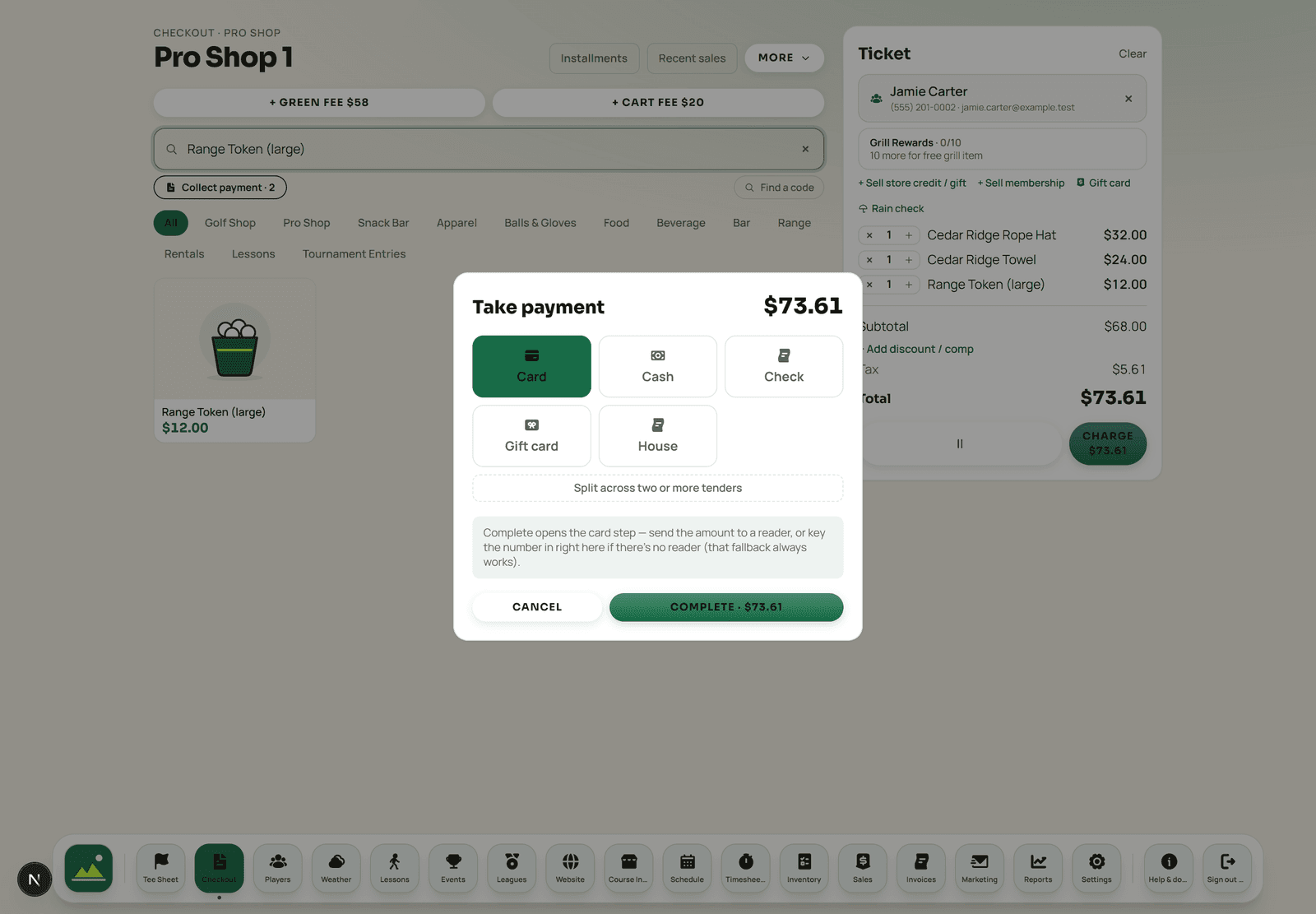 Sample data
The boundary
What Aced does, and what Stripe does
Being precise about this is the difference between a payments page and a payments claim.
- Stripe does
- Processes the card, holds the card data, runs the reader firmware, and settles funds to your bank under your own Stripe account and Stripe's terms.
- Aced does
- Builds the order, applies the rate and the tax, records the tender, posts the balanced ledger entries, and reconciles what was recorded against what settled.
- Aced is not
- A bank, a money transmitter or a payment processor. Funds do not flow through us.
- You are responsible for
- The accuracy of your prices, taxes and refunds, and for complying with card-network rules — the same as with any merchant account.
Every tender the counter needs
- Card by Stripe Terminal reader — tap, chip, swipe
- Keyed entry for phone orders
- Pay-by-QR the golfer completes on their phone
- Cash, with drawer sessions and a Z-report
- Gift cards, sold and redeemed at the counter
- Store credit held on the golfer record
- House accounts settled by invoice
- Invoices and installment schedules
- Cards on file, held at Stripe
- Two-card splits and mixed tenders on one ticket
Card payments need connectivity
Reconciliation is the point
Payment questions
Who is the processor?
Stripe, under your own Stripe account. Funds settle to your own bank. Aced is not a bank, money transmitter or payment processor — money flows through Stripe rather than through us, and your relationship with Stripe is governed by Stripe's own Connected Account Agreement.
What are the processing rates?
Processing terms are part of your written proposal rather than a public rate card, for the same reason the rest of the commercial terms are. What we will say publicly is that the arrangement is written into the quote in full, so there is nothing to discover after signing.
Can I pass card costs to the customer?
Where it is permitted, yes — surcharging is supported and documented, including how it appears to the golfer and on the receipt. Whether you should is a decision for you and your card-network obligations, not one this page will make for you.
Are cards stored on file?
Cards on file are held at Stripe, not in Aced, and an off-session charge is always bound to a specific row — an installment, an invoice, a house-account settlement — rather than floating free against a customer.
What about PCI?
Card data is handled by Stripe's readers and hosted payment surfaces; Aced does not store card numbers. That reduces your PCI scope but does not eliminate your obligations, and we do not award ourselves compliance badges. The Security page sets out the boundary in detail.
Ask the processing question directly
Processing terms live in your written proposal. Ask on the call and you will get a straight answer with the arrangement in writing — not a rate published here that would be wrong for half the courses reading it.